Mirana is easiest to make useful when a teammate starts the catch and you add a reliable Arrow. Your job is to connect control, damage and a safe exit. This lesson gives you a sequence to practise, with an annotated example you can read without playing the video.
The sequence: hold, Arrow, damage, reset
Find your setup. Identify an ally with a stun or root. Stay close enough to follow their action, without standing where the enemy will hit both of you.
Clear the firing line. Sacred Arrow stops at the first enemy unit it hits. Move sideways if creeps block the route. A longer shot is useful only if it still arrives before the setup ends.
Add damage safely. After Arrow connects, attack from range. Move in for Starstorm only when enemy disables and your escape allow it. Its second meteor hits the closest eligible enemy, so proximity matters.
Reposition. When your initial spells are spent, move back to a useful angle. Keep a Leap charge for escape when entering would otherwise trap you.
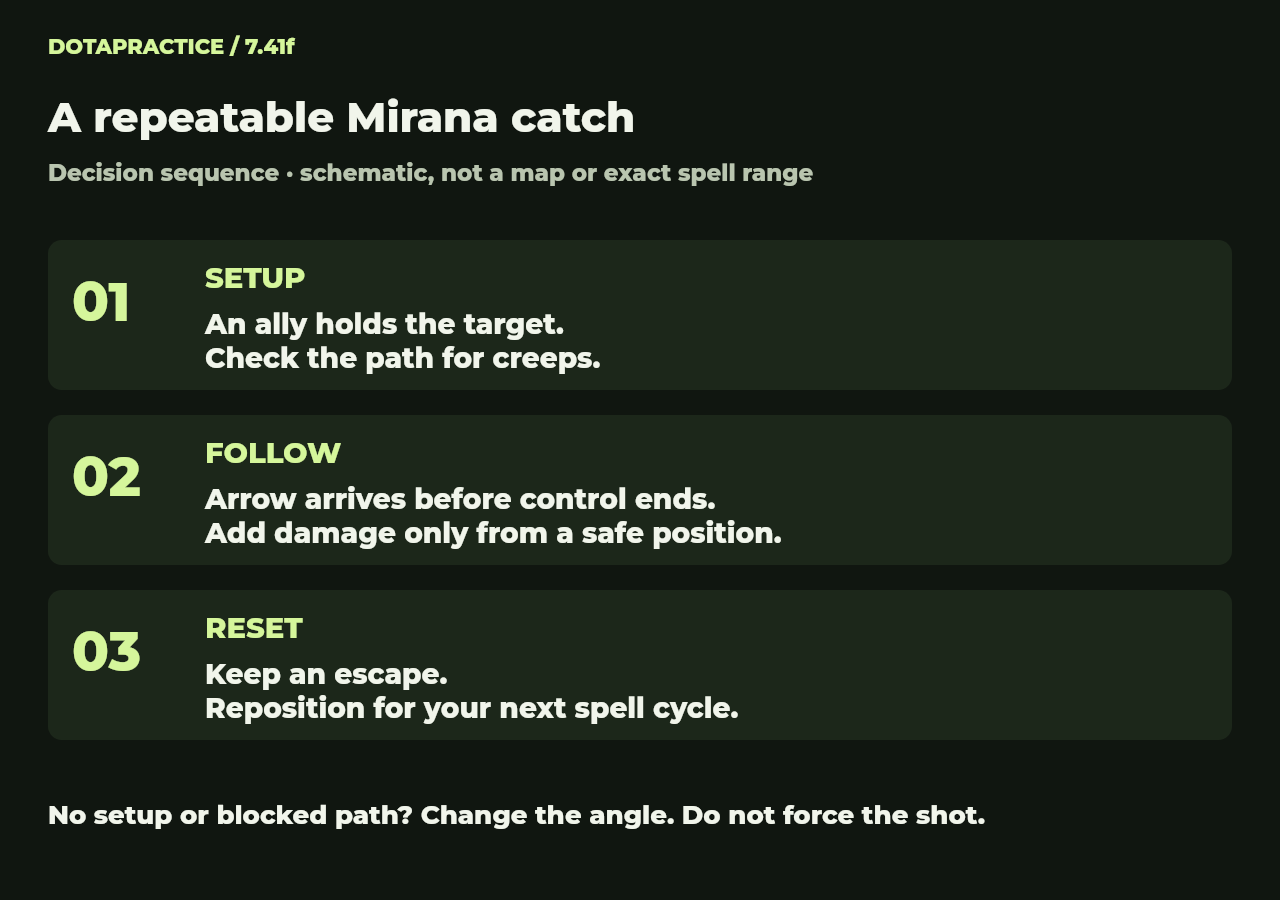
The repeatable sequence: prepare the shot, follow the control, then reset your position. The diagram is schematic; it does not show exact map geometry or spell ranges.
DotaPractice · Higgsfield / HiggseditRead this catch
In the annotated frame, 1 points to a target displaying a stun indicator. 2 marks Sacred Arrow already travelling toward the fight. 3 marks Mirana behind the front line. The useful relationship is the order: the target is held while the projectile travels, and Mirana contributes from behind.
The arrows are editorial pointers on a paused frame. After four seconds the labels clear and eight seconds of the original action play, without sound. They do not represent spell ranges or a guaranteed safe route.
1 — target under control; 2 — Arrow in flight; 3 — Mirana contributing from behind. Reproduce the sequence with an ally, then decide whether it is safe to move closer. Footage is from 7.41e; current-patch adjustments are explained below.
Support Heaven · 08:18–08:26 / Original videoTo repeat the idea, communicate before the initiation: “I have Arrow; hold them.” Check the space between you and the target, then cast early enough for travel time. Do not wait until an allied stun is almost over merely to gain more distance.
If the setup fails: save the shot or change the angle. If the enemy can move freely, aim using their visible movement rather than assuming the original plan still works. Do not walk into melee range just because you missed.
Choose a useful place to be
Your partner is the hero who can create that catch now. Before rotating, check whether they have control ready and whether your lane partner can handle the next wave.
For example, a mid ally with a ready stun is an opportunity, but leaving your carry alone under pressure may cost more than the gank gains. Help secure the wave first, then reassess. If no catch is available, protect a lane or defend an objective. Arrow instantly kills a non-ancient creep, including a siege creep: removing a catapult can be more valuable than a speculative hero shot.
What changes in 7.41f?
The example was recorded on 7.41e. In 7.41f, Celestial Quiver’s base charge restore time increased from 6 to 7 seconds. Arrow’s maximum stun is now 2.3/3.2/4.1/5 seconds by level. Close-range hits stun for less than these maximums. Early follow-up therefore has less time than in the older patch.
This does not change the order of the exercise. It makes timely follow-up more important. Avoid treating the clip’s damage or timing as a promise for every matchup.
Practise in the next three games
Review your first five Arrows aimed at heroes. Mark each one: allied setup, clear path, useful follow-up. Then record whether you survived. Improve the most common failure in the next match: change your angle if creeps intercept you; communicate earlier if control expires; keep your escape if you die after landing the shot.
Sources and optional deeper viewing
Adapted from Support Heaven’s Mirana guide, August 28 and 7.41f review, September 15. The excerpt is 08:18–08:26; annotations and exercises are by DotaPractice. Mechanics checked against Valve’s patch notes and Mirana ability data on October 6, 2026.
Discussion
Connect your ideas to heroes, items and specific patch changes.
Sign in to join the discussion
Loading comments…