The lane no longer gives you an obvious job once heroes start moving and towers fall. You can see a camp, a wave and a fight, but choosing one means giving up time for the others. Use a short loop: read the threats, choose one useful action, name your exit and reassess when it is done. This lesson is for players who know how to collect a wave but get lost afterward.
Read danger before choosing farm
Farm is the gold and experience you collect. Lane waves also move the map: when your creeps advance, opponents may have to reveal themselves to defend. Neutral camps can be convenient between waves, but spending all your time in the jungle can leave lanes pushing toward your own buildings.
Start by locating the opponents who can catch or kill you. A visible enemy on the other side of the map is information. A missing enemy is uncertainty, not proof they are waiting behind the next tree. Think about their last visible position, travel options and the time since you saw them. Then choose a route whose risk fits your hero and available help.
You do not need perfect knowledge to act. You need a reason for the risk. A fragile support walking up a dark hill alone has little room for error. The same support following an allied initiator into an area your wave and ward reveal has more information and someone to act first.
Name the next two stops
Plan a short route rather than an entire minute of farming. “This safe wave, then the nearby camp” is enough to begin. When the wave is finished, check the map again before committing to the camp. If the information changed, the route should change too.
Suppose three opponents show at the far side of the map and a side wave is approaching your remaining tower. A core who can clear it quickly may take the wave and retreat toward nearby camps. If those opponents disappear before the next wave arrives, continuing farther down the lane is a new decision. Do not treat the original sighting as permission that lasts forever.
A support may instead collect an otherwise wasted wave while the cores are busy elsewhere. Check whether a core is already returning before occupying their route. Farm priority helps resolve competition; it does not mean a support must watch uncontested resources disappear.
Identify the teammate who can make a play now
A power spike is a point when a level, spell or item makes a hero meaningfully stronger. Ask what it enables. An initiation item may let an ally start a catch; a defensive item may let them survive the response. Neither means your entire team should walk together aimlessly until somebody appears.
For a support, find an ally who has the resources to act and benefits from your spells. If you provide a stun, you need damage close enough to follow. If you provide damage, a reliable disable may be the missing piece. For a core, check whether joining means arriving while your allies can still fight.
Name the action before gathering: defend this tower, catch the hero approaching this wave, or secure vision for the next objective. “Group up” without a destination can turn five farming heroes into five waiting heroes.
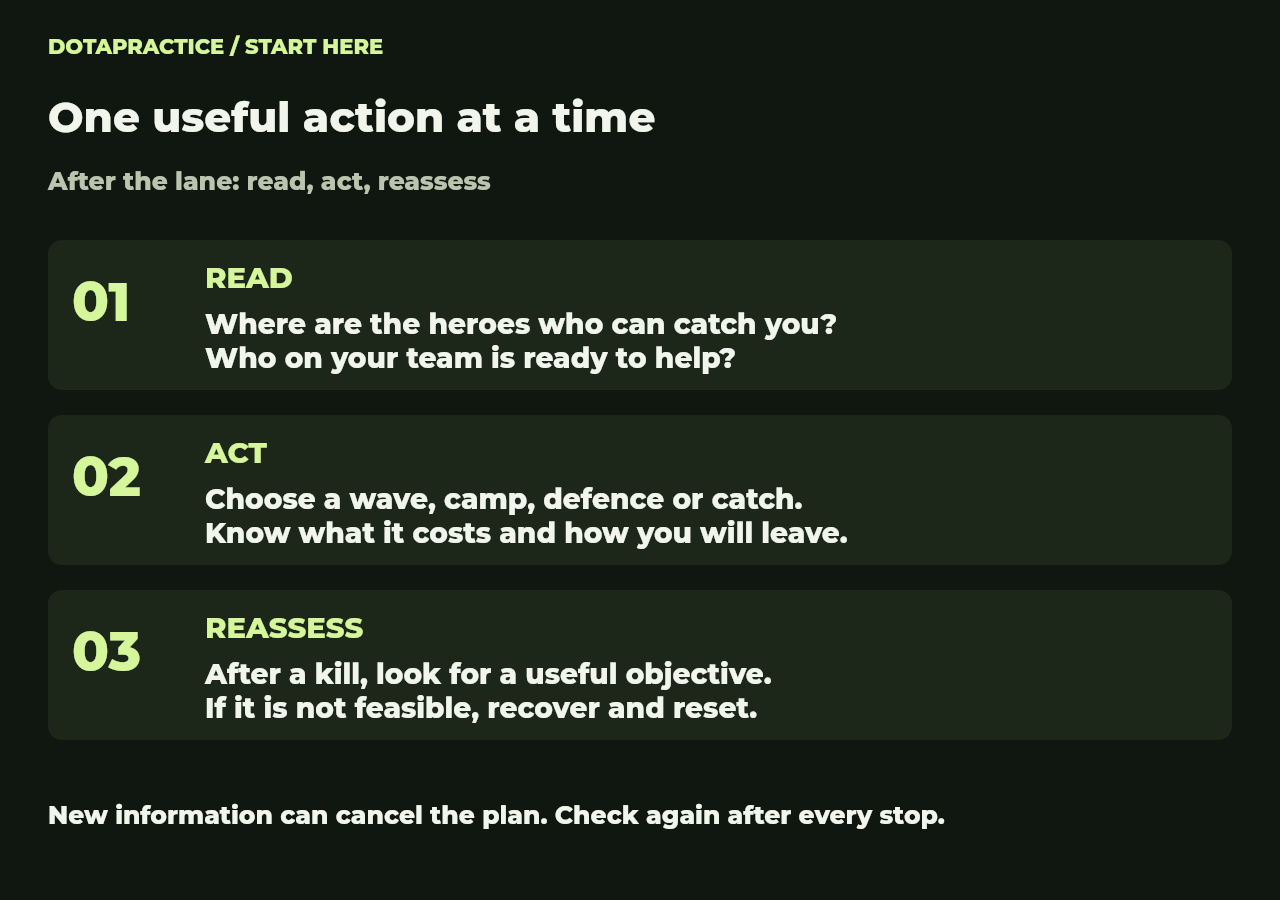
Use a short loop rather than a fixed route. Every finished wave, camp or fight is a chance to check whether your information still supports the next action.
DotaPractice · Higgsfield / HiggseditCheck a fight before travelling to it
First look at the fight itself. Are your allies still alive and able to continue? Are the enemy heroes reachable? Can you arrive before the opportunity ends? Then check the resources you need after arrival: health, mana, important spells and a retreat.
A teleport can move you quickly, but it also commits a cooldown and a landing position. Teleporting straight into a losing fight may donate another death. On the other hand, refusing every fight while farming can waste an easy defence beside your route. The useful question is what your arrival changes.
Compare: an opponent dives your tower, your ally still has a disable and you can arrive behind the tower with resources. Your presence may turn the fight. In another match, two allies have already died beyond enemy vision and the remaining ally is retreating. Arriving late may change nothing except your own location. Clear a safe wave or prepare a defence instead.
These are examples to evaluate, not automatic rules. Enemy reinforcements, saves and ready spells can reverse either decision.
After a kill, choose the reward
A kill creates time while an opponent cannot contest. Check whether that time can become an objective: a tower, Roshan, another appropriate map objective, or useful control of an area. Your team still needs damage, resources, access and enough information to attempt it.
If those conditions are missing, collect waves, recover resources or place useful vision with help. Walking toward Roshan because “we won a fight” is not enough if your team is too weak to finish before enemies return. Chasing another hero can also spend the entire opening without improving your position.
Give one short instruction: “Clear this wave and hit the tower,” or “No resources; take the wave and reset.” Reset means recover and reposition for the next action. It can include going to base, meeting the courier or backing out to a safer area; it does not always mean everyone must retreat to the fountain.
Use vision to support the plan
Place a ward where it answers a question you are about to act on. If you want a tower, seeing the enemy approach may be more useful than seeing distant camps. If you are protecting farm, vision of the path into that area matters. Seeing an enemy does not help much if the team has already committed somewhere else and cannot react.
A smoke can help a group move without ordinary vision revealing them, but it does not make walking into danger safe. Bring the teammates and spells needed for the intended action. If the route yields no target, reassess where the enemies might be instead of continuing indefinitely. Beginners can start with the destination-and-exit habit before trying elaborate smoke routes.
Playing from behind
When enemies control your usual area, first identify what remains available. One safer wave may be worth more than defending a ward you cannot reach. Wait for an opponent to reveal themselves, split away from their group or spend an important spell before considering a catch. Ask whether nearby allies can actually help; do not confuse their icons on the minimap with readiness.
Avoid making death the price of checking the map. You can give up a camp and still have a game. If every route seems dangerous, stay near a defensible position, recover and look for the next visible opening with your team.
A review you can finish in five minutes
Choose three moments after the lane where you spent time without collecting resources or influencing an objective. Pause before the movement. Write: visible threats, intended action, travel cost, exit and next stop. Do not judge only by whether you happened to survive. A good decision uses the information available at the time; an unseen enemy can still punish it. Improve one repeated mistake, such as walking toward a fight after it has already ended.
Choose a follow-up
You have completed the foundation sequence. For support, continue with Mirana: setup, Arrow and escape. For core decision-making, try Storm: the cost of farming and ganking; he is a more demanding hero, so start in a lobby or bot match. Both branches are in learning paths.
Source and patch context
Further viewing: Support Heaven's video, published August 7, 2026; relevant discussion at 03:40–04:30; 06:30–07:05. We reviewed the available captions. Explanations, teaching scenarios, diagrams and exercises here are DotaPractice's own. This is a fundamentals lesson for the 7.41f learning series, not a copied build or a promise about every matchup. Older footage may show different item values or map timings; check current in-game tooltips. Prepared October 7, 2026.
Discussion
Connect your ideas to heroes, items and specific patch changes.
Sign in to join the discussion
Loading comments…