Your first job in a Dota lane is to collect experience and gold without losing so much health that you cannot approach the next wave. A kill can help, but a chase that costs you two waves can leave you weaker than the opponent you killed. This lesson explains the lane as a sequence of small decisions you can practise in a bot match and then use with a partner.
Know what you are trying to collect
Lane creeps are the units that walk out of each base in waves. A last hit is the attack or spell that kills an enemy creep and earns its gold. You gain experience by being close enough when enemy units die, even if you do not land the final blow. Denying means finishing an eligible allied unit before the opponent can claim it; for now, learn your own last hits before trying to contest every deny.
In a usual two-person side lane, the core takes most last hits while the support helps them approach the wave. The positions numbered one to five describe farm priority, not personal importance. A support can take a creep the core cannot reach; a core can use a spell to help a support escape. Agree on the lane jobs before arguing about the scoreboard.
For your first practice, use one familiar hero. Learn how long its attack takes to land. With a ranged hero, include the projectile's travel time. Repeatedly switching heroes makes it harder to tell whether you misread the creep's health or simply misjudged your attack animation.
Watch the next creep, not only your hero
Pick the enemy creep that will die next. Watch which allied units are attacking it, then begin your attack early enough for the hit to arrive at low health. If you click too early, the creep survives and another attack may finish it. If you click too late, it dies before your hit arrives. The correction is different, so notice which happened.
Between last hits, move a short distance to a useful position. Avoid automatically attacking the healthiest creep: those extra attacks change how quickly the wave dies. A useful beginner drill is five minutes of last hitting without an opponent. Record your result, repeat with the same hero and compare with yourself. The number is a baseline, not an exam you must pass before playing.
Once timing feels comfortable, add a bot opponent. You now have a second task: deciding which last hits are worth approaching. Giving up one creep can be correct if taking it lets both enemies attack you.
Choose where the wave meets
Wave control means changing where the two groups of creeps fight. Near your tower, the retreat is shorter. Far down the lane, enemies have more room to chase. But standing under a tower does not make you invulnerable, and a huge enemy wave can still make the position difficult.
When both waves are similar in size, avoid unnecessary attacks if you want the meeting point to stay nearby. When a large enemy wave approaches, help reduce it before trading with heroes. “Keep the wave near me” does not mean “let every enemy creep survive.” Their damage still matters.
Creep aggro is their choice of attack target. In a practice lobby, stand near enemy lane creeps, issue an attack order on a visible enemy hero, then walk a short distance back. When the creeps switch toward you, you can move the fight toward a more convenient last-hit position. Stop if the attempt puts you in reach of both opponents. Practise the response before trying repeated pulls of aggro in a contested lane; the mechanic has a cooldown, so every click will not produce a new movement.
This is different from a support pull, where neutral camp creeps intercept your own lane creeps. Pulling needs a separate decision about the lane and your partner; the next lesson covers it.
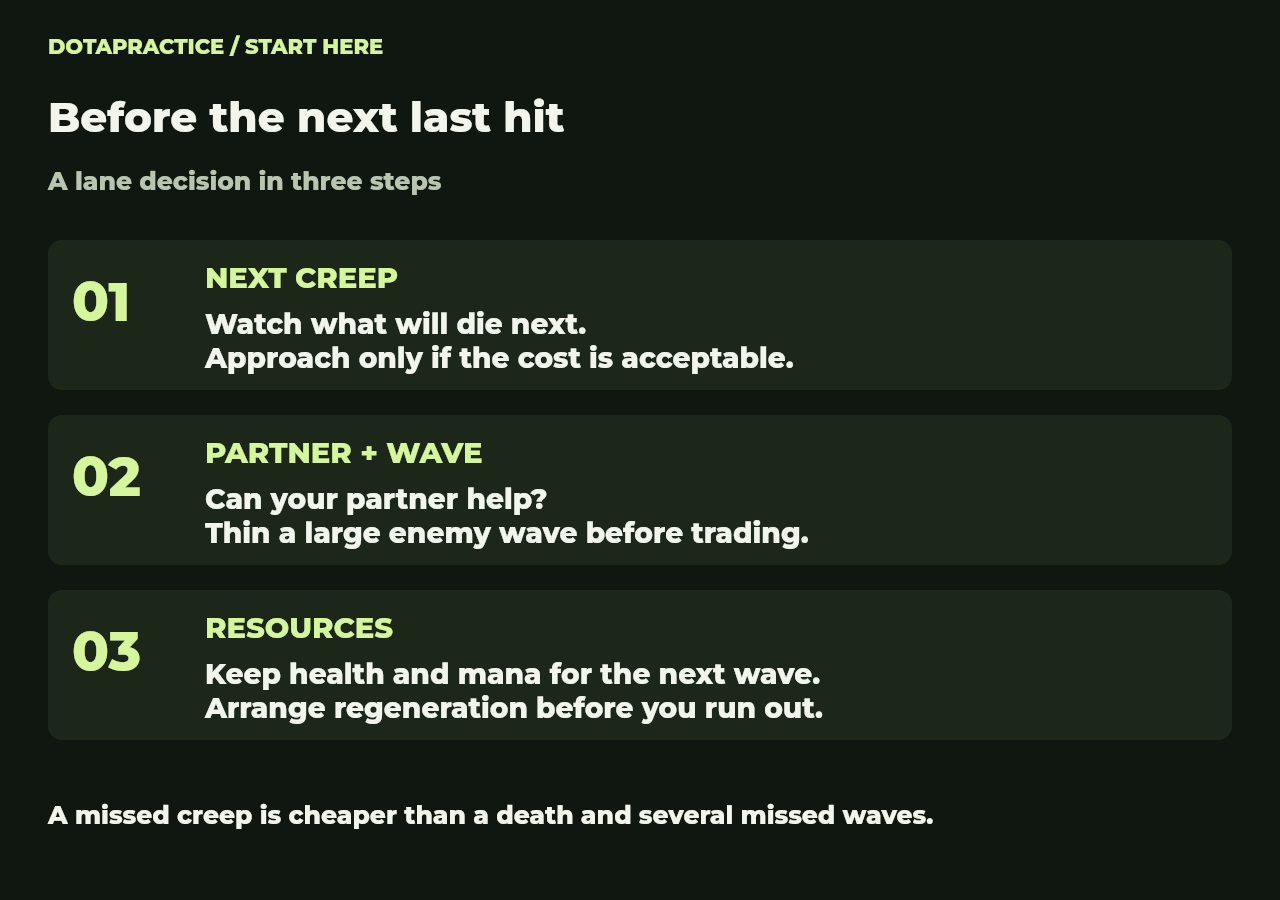
Read the next creep, the local fight and your resources together. The decision changes when your partner moves or a larger wave arrives.
DotaPractice · Higgsfield / HiggseditTrade health for a reason
A trade is an exchange of attacks or spells. Before starting one, look at three things: nearby creeps, your partner's position, and the health and mana you need afterward. An enemy alone on the side of the lane may be vulnerable. The same enemy beside their partner and a large wave is a different fight.
Suppose your partner is about to secure a low-health ranged creep. You run past the wave to hit the enemy support. Your partner now has to choose between following you and finishing the creep. You did not create a two-against-one opportunity merely because two allied heroes are in the lane. Wait until they can participate, or take a short trade that you can leave yourself.
Conversely, if the enemy support walks into reach of both of you while their core is occupied farther away, attack together and then reassess. Do not continue chasing after the local advantage disappears. The objective might be to drive the support away long enough to collect a wave, rather than to kill them.
Keep enough resources for the next wave
Regeneration replaces health or mana you spend. Arrange delivery before your remaining supplies run out. If you wait until you cannot approach the wave, the courier's journey becomes lost lane time. Read the item tooltip: different regeneration items have different interruption rules and conditions.
Mana sitting unused does not protect your partner, but spending every spell to poke an enemy can leave you unable to secure a contested creep or escape. Before casting, name the purpose: secure a creep, win a short trade, protect a partner or threaten a kill. This is easier to review than “I should use more spells.”
When the lane goes wrong
If the enemies become stronger, first ask whether you can still collect experience safely. Move back, recover resources and ask for help with a specific problem: “They can dive me when the next wave arrives.” A ping is a request, not proof that someone will teleport.
If help cannot arrive, concede the dangerous last hits. Moving to the jungle is useful only if your hero can actually clear those camps without losing too much health or time. You can also check for an unoccupied safer lane. There is no single minute when every hero must leave.
Practise one correction over three games
After each game, review the first three times you were forced away from the wave. Write down the cause before the damage started: a solo trade, a large enemy wave, missing regeneration or an enemy level advantage. Choose one correction for the next match. A good result is not just more last hits; it is fewer avoidable periods when you cannot play the lane at all.
Your next step
Continue with support lane jobs and rotations. Even as a core, this helps you understand when your partner can leave. See the complete order in learning paths.
Source and patch context
Further viewing: BalloonDota's video, published September 24, 2026; relevant discussion at 07:31–09:44. We reviewed the available captions. Explanations, teaching scenarios, diagrams and exercises here are DotaPractice's own. This is a fundamentals lesson for the 7.41f learning series, not a copied build or a promise about every matchup. Older footage may show different item values or map timings; check current in-game tooltips. Prepared October 7, 2026.
Discussion
Connect your ideas to heroes, items and specific patch changes.
Sign in to join the discussion
Loading comments…