Storm Spirit can reach a side-lane fight quickly and still make the wrong move. Judge a rotation by its expected reward, the resources it consumes and what you can do afterward. A kill that leaves you stranded without mana may not solve your team’s problem.
What you should know before practising this
Storm is an intermediate hero to learn through this lesson. You should already be comfortable collecting a wave, looking at the minimap and checking enemy disables. Gank means an attempt to catch an enemy with a rotation; tempo describes your ability to make useful actions before the opponent can answer. Moving quickly only creates tempo when the destination is worthwhile.
Practise in a bot match before applying this in ranked. Start with one task: complete a short approach, use your spells and attacks, then leave with mana remaining. Learning the exit at the same time as the entry prevents a common habit of treating every jump as a commitment to die or kill.
Before a gank, answer four questions
Who is the target? Pick a reachable enemy. Check their escape and any nearby ally who can save them.
Who helps? An allied stun is useful only if its owner is close enough and ready. A ping alone is not a coordinated attack.
What does the whole play cost? Budget for the approach, your spell sequence and a retreat. Ball Lightning costs mana both to activate and over distance. A fixed mana percentage cannot make every jump safe.
What comes next? Name the reward and your return route: protect a tower, take an objective with allies, or return to a safe wave. Know what you will miss in mid.
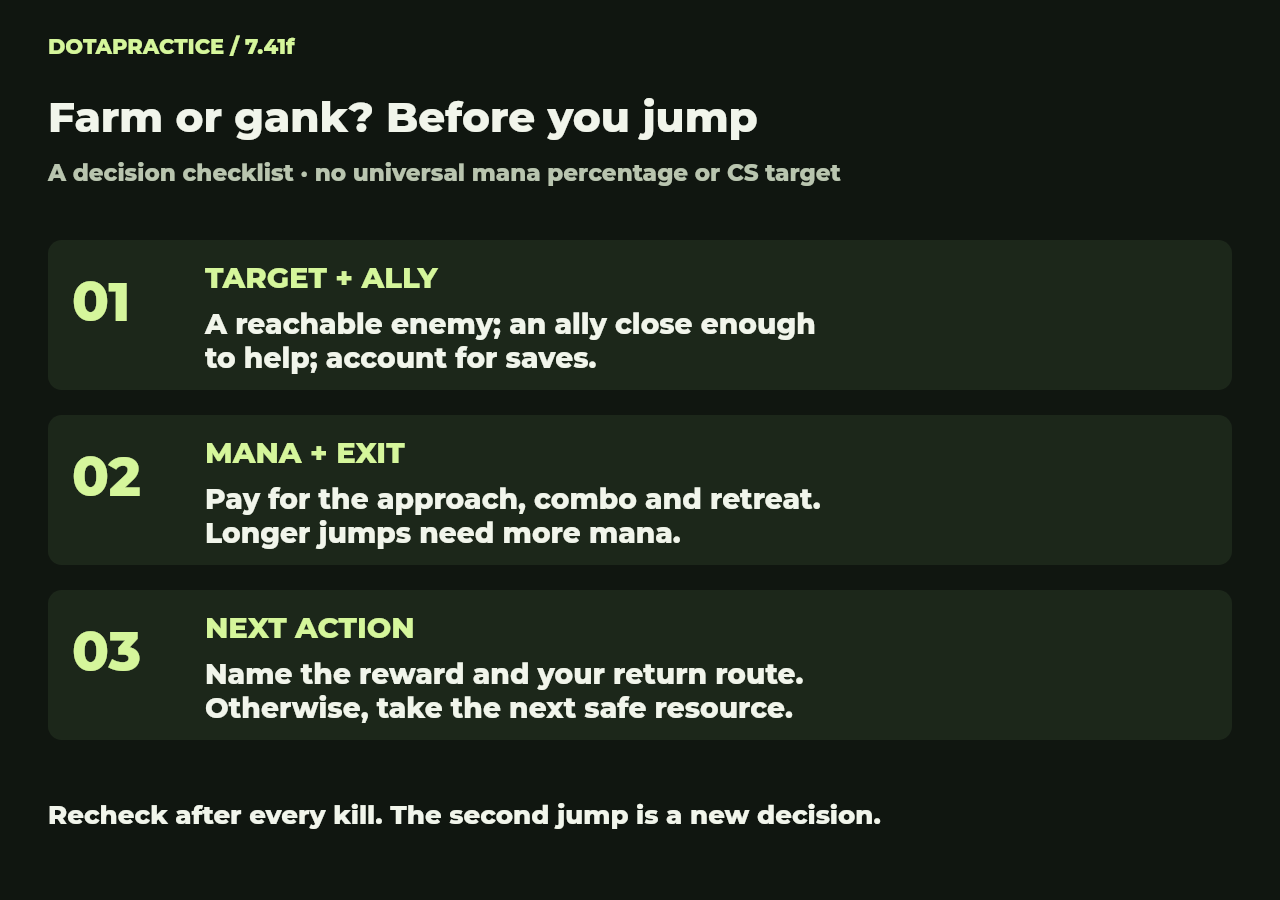
Four questions, grouped into three steps: target, help, total resource cost, and what happens afterward. A weak answer is a reason to reassess before jumping.
DotaPractice · Higgsfield / HiggseditPrepare the lane you are about to leave
Suppose a support pings an enemy in a side lane while an enemy wave is about to reach your mid tower. If you leave immediately, the rotation costs that wave as well as the travel. If you can clear it safely first, you may create a better window. But if clearing it takes so long that the target is gone, the right response may be to cancel the gank rather than arrive late.
Look at your teammate directly. Are they moving toward the target or retreating? Do they have the health and mana to help? State a short plan such as “I can come after this wave; keep your stun.” A ping is useful coordination, but it does not establish that the ally can execute your imagined combo.
At level six, Ball Lightning gives you a new movement option. It does not automatically make every side lane more valuable than your own resources. Check the same target, ally, total cost and next-action questions every time.
Learn what your mana is buying
The mana bar pays for more than reaching the enemy. It also pays for your control and damage, another movement if the target shifts, and the escape. Longer Ball Lightning travel costs more; repeatedly casting short jumps also repeatedly pays the activation cost. Neither “always make one long jump” nor “always use tiny jumps” is a sufficient rule.
In a lobby, keep your level and items fixed. Try a short approach, your intended spell sequence and a short exit. Note the starting and ending mana. Repeat with a longer approach. Then repeat after changing your items. The aim is to build an estimate for the version of Storm you are actually playing, not memorise a mana percentage from someone else's clip.
Overload makes your next attack release a charge after a spell cast. Ordinary charges from casts do not stack. When it is safe, fit an attack between casts so you use the available charge instead of replacing it without attacking. In danger, immediate control or escape can be more important than squeezing in that attack. Test the sequence without enemy pressure before making it faster.
A missed opportunity is not a debt you must repay
Imagine you jump toward a target, but they move behind allies before you arrive. The original plan is gone. Spend the resources needed to leave while you still can, then recover. Chasing farther because you already spent mana compounds the cost.
The same applies after a successful kill. If the first target dies, your control is unavailable and two opponents disappear from the map, the next jump may be much worse than the first. Check again before pursuing. Surviving with enough resources to collect the next wave can preserve the benefit of the kill.
Connect an item to the problem it solves
Before buying a major item, name the obstacle: getting silenced before you escape, lacking enough damage in the available control window, or running out of resources during a normal route. Read the current item description and consider the enemy response. A copied build cannot answer which obstacle is deciding this match.
When the item arrives, plan one action it now enables, with allies who can participate. If its active is unavailable or enemies are positioned to counter you, wait for a better window. Owning the item and having its protection available are different states.
When the answers are weak, connect safe resources
Start with a wave you can safely collect, then choose a nearby camp that fits before your next useful lane visit. “Wave → camp → reassess” is a decision loop, not an order to farm the same area regardless of enemy movement.
Imagine you clear mid, see the enemy mid elsewhere and can reach a nearby camp without entering unwarded enemy territory. You have a short route to consider. If two threatening heroes then disappear, recheck the route instead of following your original plan automatically.
Stack only when you or a teammate can realistically collect the stack. Walking a long detour to stack while a safe wave dies is not automatically efficient.
Read this farming moment
The excerpt shows Storm using damage and attacks to clear neutral creeps, then moving on. The freeze-frame highlights 1, the nearby camp; 2, his remaining mana; and 3, the minimap. It illustrates what to inspect before choosing the next stop, rather than proving the entire route is safe.
1 — camp being cleared; 2 — mana left for the next action; 3 — minimap to check before moving. The useful habit is to choose the next safe stop after each camp. This is an example of resource use, not a claim that the whole route is safe.
justhatemeee · 09:04–09:12 / Original videoAfter a camp, ask: “Where is the next safe wave, and can I reach it with enough resources to leave?” If the answer is unclear, reset or choose a safer resource. Do not spend your escape mana simply to move a few steps faster while enemies are missing.
Compare two possible rotations
Worth evaluating: an enemy dives your side-lane tower, your support has a ready disable, your teleport is available and you can afford both the fight and the exit. Check that help can actually arrive before committing.
Low confidence: a healthy enemy is near their own tower, your ally is retreating and you would need a long jump just to reach them. Unless new information changes the situation, finish the next safe action instead of spending time on a hope.
Neither example guarantees an outcome. They make the information you need explicit, so you can explain your decision after the game.
Stop when the advantage ends
After a kill, check mana, enemy positions and defensive cooldowns again. The second target is a new decision. State one next action to the team, then do it. If your defensive item is on cooldown, do not plan the next jump as though its active protection were available.
A five-minute replay exercise
Review minutes 6–11. For every departure from mid, write one line: intended reward, waves missed, mana spent, result and next action. Include successful ganks. Find one repeated cost you could avoid, such as waiting too long for a target or returning without a plan. Practise that correction for three matches instead of chasing a universal creep-score target.
Patch context and sources
The clip is from justhatemeee’s August 3 Storm guide, 09:04–09:12, recorded on 7.41e. Annotations, examples and exercises are by DotaPractice. Patch 7.42 changed Storm slightly: a little more Intelligence and attack damage, and more mana regeneration from each Galvanized charge (0.25 instead of 0.2). His level 10 and level 15 talents swapped places: the Overload slow is now at level 15, and level 10 gives +175 health. None of this changes the mana budgeting in this lesson. Ball Lightning’s activation and distance costs are unchanged. Use this lesson for decisions, not a copied build. Mana mechanics were checked against Valve’s 7.42 ability data on November 19, 2026.
Build the foundation
For the general decision behind this hero lesson, read lane fundamentals and choices after the lane. Find the recommended order in learning paths.
Discussion
Connect your ideas to heroes, items and specific patch changes.
Sign in to join the discussion
Loading comments…